


Blog
Cream Embroidery: A Fine Art from Sistan and Baluchestan

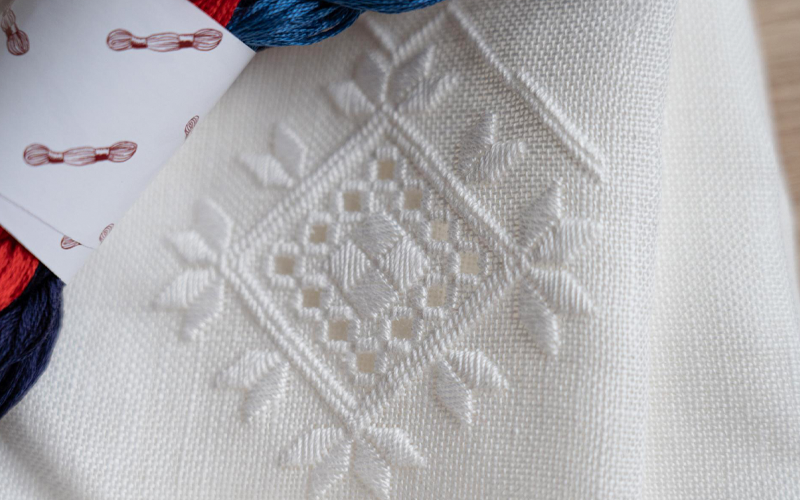
Khameduzi, or in the local language “Khamakduzi”, is an authentic and deeply rooted art from the ancient land of Sistan. This beautiful art, with a history of more than a thousand years, represents a fusion of the history, culture, and aesthetics of the people of this region of Iran. Khameduzi is not only a manifestation of elegance and precision in handicrafts, but today it can be a bridge for entrepreneurship and hope in deprived areas of our country.
What is cream embroidery?
Khameduzi is a traditional type of needlework that is done using raw (unspun) silk thread on woven fabrics. Unlike many sewing arts that have a preliminary design, in Khameduzi, the artist creates the patterns without a previous design and relies solely on his mental and visual skills.
Because these threads are untwisted and very delicate, working with them requires great skill to prevent the thread from unraveling or tangling. This characteristic makes cream embroidery one of the most difficult and time-consuming types of embroidery, but the end result is a stunning, precise, and perfectly symmetrical work.
The process of creating a work
It takes about 30 hours to sew a pair of cushions with cream embroidery, while creating a two-meter tablecloth can take nearly a month. These works are usually created by Sistani women artists who have learned the art from their mothers and grandmothers for generations.
Behind the Scenes of Art; Living Conditions in Sistan and Baluchestan
Sistan and Baluchestan was once a prosperous land with mulberry orchards and silk production. Artists in the region produced the raw materials for their works by hand. But for years, successive droughts have destroyed agriculture, livestock farming, and other sources of livelihood.
Today, many people in this land struggle with unemployment, and in such circumstances, arts such as embroidery can be a new hope for generating income and preserving indigenous culture.
Women artists: the main pillar of this ancient art
Women in Sistan and Baluchestan are introduced to sewing and embroidery from childhood. For many of them, the art of embroidery is not only a way to express their artistic taste, but also a way to financially support their families. Unfortunately, due to their geographical distance from commercial centers and lack of access to marketing and entrepreneurship training, they have not been able to introduce this art to the market on a large scale.
The importance of supporting the Khamehdozi
Promoting and supporting this noble art does not just mean purchasing a work of art. Each piece of embroidery purchased actually:
Creating job opportunities for female artists in deprived areas;
Supporting the family economy in one of the most challenging areas of the country;
Preservation and revival of an ancient and forgotten art;
It is a small step towards restoring prosperity to the mythical land of Sistan and Baluchestan, the birthplace of Zal and Rostam.
Sistan, a treasure trove of history
Sistan and Baluchestan is not only the land of embroidery, but also the cradle of a 5,000-year-old civilization. One of the amazing examples of this civilization is the clay cup discovered near Zabol, which displays the world’s first moving image. Valuable artifacts such as the surgically removed skull and artificial eye discovered in Shahr Sokhteh are a testament to the scientific and artistic progress of the people of this land.
We are ambassadors of hope.
During our close-up visit to the conditions of this region, we deeply felt that entrepreneurship for these genuine, kind, and hospitable people is not only a social responsibility, but also a human duty. By supporting the art of embroidery, we can play a small but effective role in the lives of our fellow countrymen.
By publishing this article and introducing this art, we can be the voice of artists who have been creating beauty in silence for years.
Thank you for your support
. Promoting art is promoting humanity.